Creators
Review your own videos to see which themes, formats, and publishing choices attract stronger reactions.
You get a clearer starting point for planning the next batch of content instead of relying on one viral result.
exolyt for tiktokTikTok intelligence
what is exolyt tiktok analytics? It is a way to turn public TikTok signals into practical context about accounts, videos, hashtags, and audience activity. Use the findings to compare patterns, shape content decisions, and spot changes worth investigating.

Practical value
Exolyt analytics helps different TikTok users replace scattered observations with a repeatable view of what is happening and what to examine next.
Review your own videos to see which themes, formats, and publishing choices attract stronger reactions.
You get a clearer starting point for planning the next batch of content instead of relying on one viral result.
exolyt for tiktokCompare your visible TikTok presence with relevant accounts and note recurring patterns in content and engagement.
You can prioritize ideas that fit your audience and avoid copying isolated tactics without context.
exolyt examples tiktokTrack public account, hashtag, and video signals while studying a category, trend, or community over time.
A structured evidence trail makes qualitative TikTok research easier to review and discuss.
exolyt tutorial tiktokUse a consistent framework when preparing client updates about competitors, campaigns, or emerging topics.
Teams can share observations in a common format and separate useful signals from assumptions.
exolyt calculatorCore mechanisms
The value comes from combining several views rather than treating one visible number as the complete story.
 01
01
1
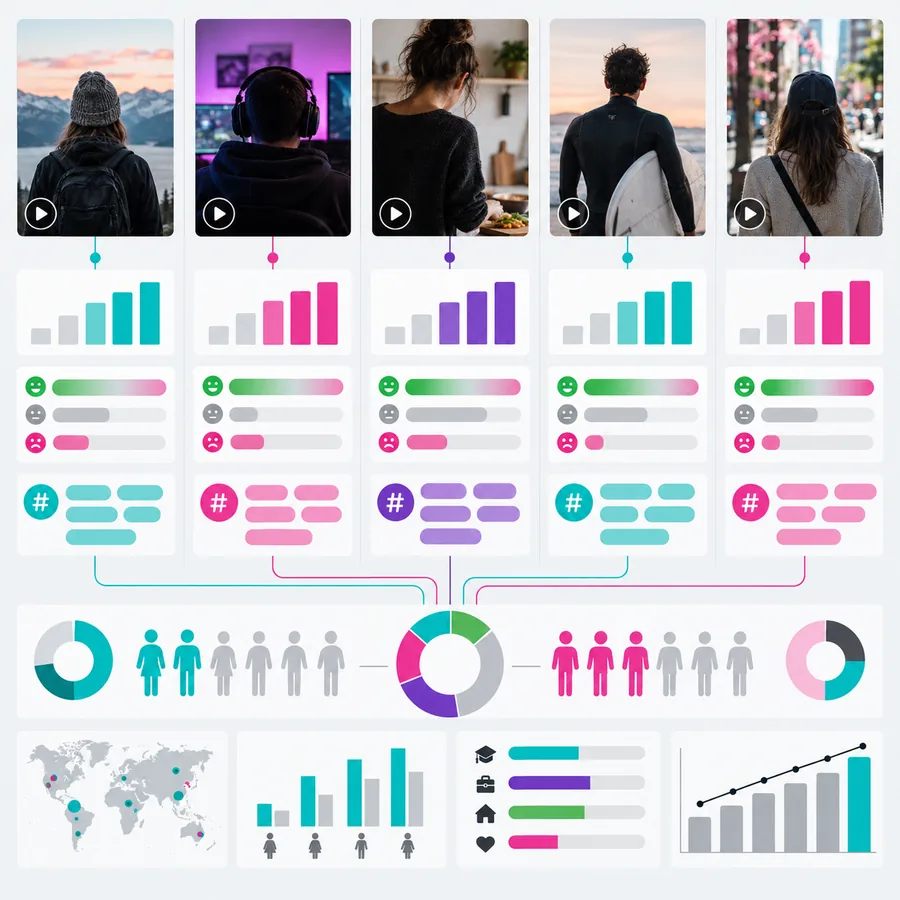
Start with the account as a whole. Review visible activity, content themes, and audience response patterns to understand the position a creator or brand occupies on TikTok.
 02
02
2
Move from the account to individual videos, hashtags, and topics. This makes it easier to notice which subjects are gaining attention and how different formats support them.
 03
03
3
Finally, translate observations into a next action: investigate a competitor, refine a content idea, or return later to see whether a pattern persists.
Simple workflow
A useful review does not need to begin with a complicated report. Start broad, narrow the question, then validate what you found.
Select an account, video, hashtag, or topic that matches the question you are trying to answer.
Read the available activity and engagement context together, checking several related items rather than one isolated result.
Write down the pattern, its evidence, and the next action you will take or monitor.
Use with care
Analytics can organize public signals, but it cannot remove uncertainty or explain every reason behind a viewer’s behavior.
A public-facing view may not include private account information, hidden audience details, or every metric used internally by a creator.
WorkaroundTreat the result as directional context and pair it with first-party data when you own the account.
A high-performing video may coincide with a sound, timing choice, or trend without proving that one factor caused the result.
WorkaroundCompare several related posts and test one change at a time before making a firm claim.
TikTok attention can move before a report or review reflects the latest activity, especially during fast-moving moments.
WorkaroundAdd a review date and revisit important findings instead of treating them as permanent facts.
Engagement figures and rankings are easier to misread when audience size, format, age, and topic are ignored.
WorkaroundCompare like with like and explain the comparison set beside every conclusion.
Continue exploring
Use these focused pages when your question shifts from understanding analytics to applying a specific workflow.
From signal to sense
The difference is not simply more numbers. It is the move from a single visible result to a comparison that includes context and a reason for looking.
Compare patterns before drawing conclusions.


Choose your lens
The same public signals can answer different questions depending on who is reviewing them and what decision comes next.

Creators can use analytics to review what they have already published, identify themes worth developing, and build a more deliberate testing habit.

Brands can examine visible competitor and category activity without treating every successful post as a template to copy.

Researchers can use a consistent review process to preserve what they saw, when they saw it, and how the observation supports a broader question.
Make the next review useful
Start with one account, topic, or content pattern. Review the surrounding context, record what is supported, and use the result to choose a focused next step rather than chase every metric.
Explore ExolytCommon questions
These answers cover the basic meaning, use, and boundaries of TikTok analytics.
It is used to organize visible TikTok signals around accounts, videos, hashtags, and topics. The goal is to support research, content planning, competitor review, and more consistent interpretation.
It can help identify patterns associated with a video’s visible performance, such as topic, format, timing, or audience response. It cannot prove that one factor caused the result, so findings should be treated as evidence for a hypothesis rather than a complete explanation.
No. TikTok’s native analytics are first-party reporting for an eligible account, while an external analytics view focuses on organizing and comparing available public signals. First-party data is the better source for private account details and internal metrics.
You can use public signals to compare visible activity, content themes, and patterns across relevant accounts. Competitor review is most useful when the comparison set and review date are recorded, because public activity and trends can change.
Read it alongside account size, content type, topic, timing, and comparable posts. A single number rarely explains performance on its own, so compare several related items before turning it into a recommendation.